Izzy Hodnett › Work › Social Current Standards
Social Current Standards
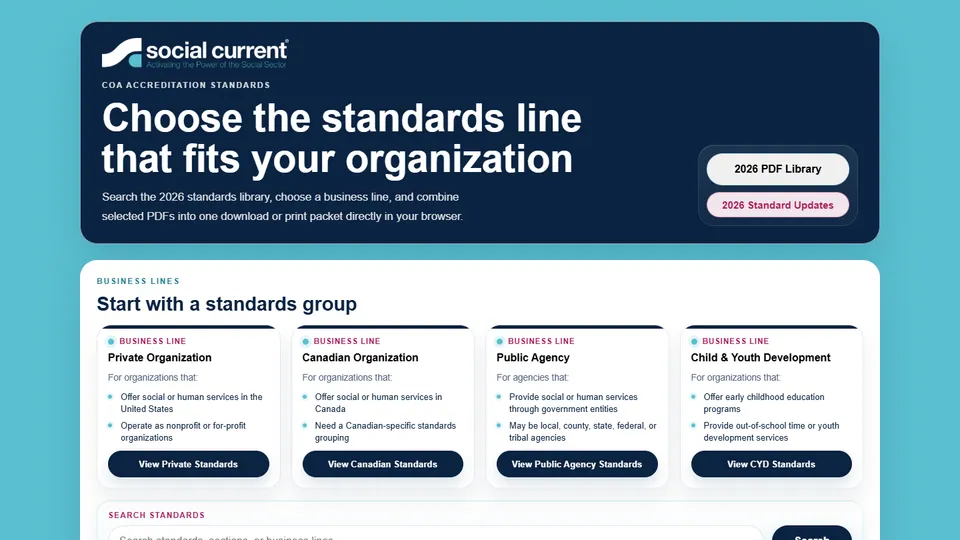
The accreditation standards, published as something an organization can actually navigate instead of a document it has to scroll.
The problem it solves
Organizations being accredited are measured against a long set of written standards. Those standards were published in a form that was hard to move around in, so people could not reliably find the section that applied to them. That produced complaints from the organizations using it, and it produced workarounds inside the office — coordinators keeping their own notes and shortcuts because the official source was slower than doing it themselves.
How it works
- The full text of the standards is held in a structured form rather than as one long document, so each section is a thing the site can point at directly.
- A reader searches or moves through the sections, and lands on the specific standard rather than on a page they then have to scan.
- It is a public site with nothing to sign into, because the people who need it are outside the organization.
How it is kept safe
- It went through the organization's own information technology and marketing review before launch, and is linked from the main Social Current site.
- It holds no personal information and has no accounts, so there is nothing in it that could be exposed.
What this is built with
Each part, and what it does, in plain terms.
- Hosting
- Where the site actually runs. These run on Cloudflare, the same service that carries traffic for a large share of the web, so pages load from whichever of its locations is nearest the reader.
- A web page people use
- The site itself, the screens people click through. It opens in an ordinary browser, so there is nothing for anyone to install.
- Search
- An index built in advance so a large reference can be used quickly. It finds an entry from a partial word instead of making someone scroll.